
HerWILL Completes AI for Digital Safety Datathon 2026 With Global Participation and AI4OPT Collaboration successfully completed the “AI for Digital Safety Datathon 2026,” a global initiative that brought together participants from more than 45 countries to address the growing challenge of harmful online content through artificial intelligence.
The initiative engaged more than 2,167 participants across over 60 institutions and multiple regions worldwide, including contributors from Egypt, Bangladesh, Syria, Senegal and many others. Organizers said the program highlighted the importance of building responsible, context-aware artificial intelligence systems for increasingly complex digital environments.
AI4OPT Partnership Advances Responsible AI Collaboration
The datathon was supported through a strategic collaboration. The partnership reflects AI4OPT’s broader mission of advancing artificial intelligence and optimization research while also contributing to global workforce development and responsible AI education.
HerWILL and AI4OPT maintain a long-term collaboration focused on bridging advanced research with applied learning experiences. Together, the organizations aim to move participants from structured training into applied research, global competition and leadership in responsible AI systems.
AI4OPT Researchers Contribute as Judges and Panelists
AI4OPT leaders and researchers played active roles throughout the program.
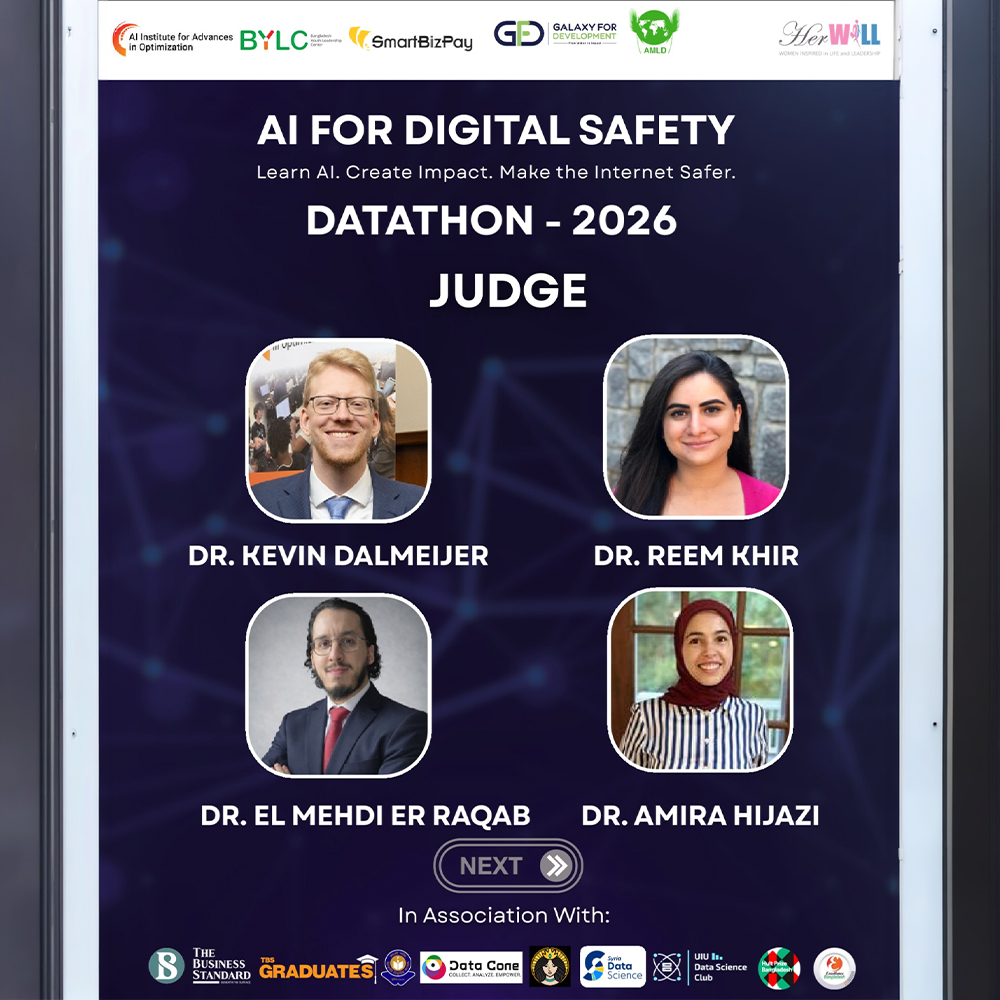
Kevin Dalmeijer, managing director of AI4OPT, served as a judge for the competition and represented the institute in its collaboration with HerWILL. Amira Hijazi, El Mehdi Er Raqabi, and Reem Khir also served as judges, contributing expertise in machine learning, supply chain optimization and artificial intelligence research.
Kevin Dalmeijer also participated in a panel discussion on responsible AI alongside Reza Zandehshahvar, focusing on the ethical development and deployment of AI systems in real-world applications.
In addition, a HerWILL AI workshop concluded its applied deep learning segment with instruction led by students and research faculty, including Jin Xu, Kaigie Xie, Mark Seferian, and Thomas Bruys, helping participants transition from theory to hands-on model development.
Advancing AI for Digital Safety
The datathon focused on developing AI systems capable of detecting harmful online content, including explicit, subtle and neutral forms of toxicity. A key emphasis was placed on multilingual and low-resource language contexts, where traditional AI systems often struggle.
Participants completed a seven-day training series covering machine learning, natural language processing and applied deep learning before competing using a real-world, human-annotated dataset.
Key technical focus areas included:
- Detection of subtle toxicity beyond binary classification
- Handling code-mixed language such as English, Bangla and Banglish
- Evaluation using balanced metrics including the F1NOP metric
- Development of scalable multilingual AI safety systems
The program also contributed to the creation of a large-scale multilingual dataset of nearly 60,000 annotated samples, supporting ongoing research in AI safety and content moderation.
Global Winners Recognized
The competition recognized three top performers from a highly competitive field:
- Azra Tuni from Bangladesh, champion
- Nour Mohammad from Syria, first runner-up
- Syed Zayan Anwar from Bangladesh, second runner-up
Finalists represented countries including Bangladesh, Syria, Egypt and Cameroon, demonstrating strong technical expertise and a deep understanding of real-world digital safety challenges.
Organizers emphasized that the initiative reflects how globally connected learning models can translate into meaningful AI solutions that strengthen digital safety systems.
Congratulations to all winners, finalists and participants for their contributions to advancing responsible artificial intelligence and building safer digital environments worldwide.
AI FOR DIGITAL SAFETY

