
Over the past year, Michael Boateng, a Georgia Tech electrical and computer engineering doctoral student, has contributed to power systems research at Los Alamos National Laboratory (LANL), participated in an intensive Argonne National Laboratory training program, mentored students through STEM outreach and continued developing MPowerBoards, an educational technology startup supported by Georgia Tech’s CREATE-X program.
Together, these experiences have expanded how Boateng approaches engineering challenges, from developing AI-driven solutions for power systems to making complex concepts more accessible through hands-on learning.
Finding a Research Home
After earning a bachelor’s degree in electrical and electronics engineering from Ashesi University in Ghana, Boateng came to Georgia Tech interested in combining his engineering background with machine learning and artificial intelligence.
That interest led him to NSF AI4OPT.
“AI4OPT felt like the perfect place,” Boateng said. “I received great advice from people around me to explore the institute, and that is how I found my research home here.”
Through NSF AI4OPT, Boateng began applying AI and optimization to power systems while collaborating with researchers across academia, industry and national laboratories. One of those connections eventually led him to LANL and a project that became central to his doctoral research.
From Campus to National Labs
As a graduate student intern at LANL, Boateng worked on improving power system operations through optimization and machine learning.
His primary project focused on AC feasibility restoration, which helps optimization models produce solutions that better reflect the physical constraints of electrical grids. The work has contributed to publications, research submissions and ongoing collaboration between researchers at Georgia Tech and Los Alamos.
“The most valuable part is that these opportunities are connected to the research itself,” Boateng said. “I can develop an idea at Georgia Tech, discuss it with collaborators, and better understand how it might apply to real systems.”
His contributions earned him the 2026 LANL Distinguished Student Performance Award, making him one of eight students recognized across the laboratory.
While in New Mexico, Boateng also volunteered with STEM Santa Fe, helping students complete hands-on electronics projects. The experience reinforced his interest in making complex engineering concepts easier to understand.
His work also led him to research the computing infrastructure needed to solve larger power system problems. In 2026, he participated in the Argonne Training Program on Extreme-Scale Computing (ATPESC), where 75 graduate students, postdoctoral researchers and scientists spent two weeks learning advanced high-performance computing (HPC) techniques.
“HPC is increasingly important to my work because we combine machine learning and optimization on large power-system problems,” Boateng said. “The goal is not only to develop good algorithms, but to understand how they execute and how they can scale.”
At the end of the program, participants received computing nodes from Argonne National Laboratory’s retired Mira supercomputer. Boateng saw the experience as a reflection of the program’s collaborative spirit.
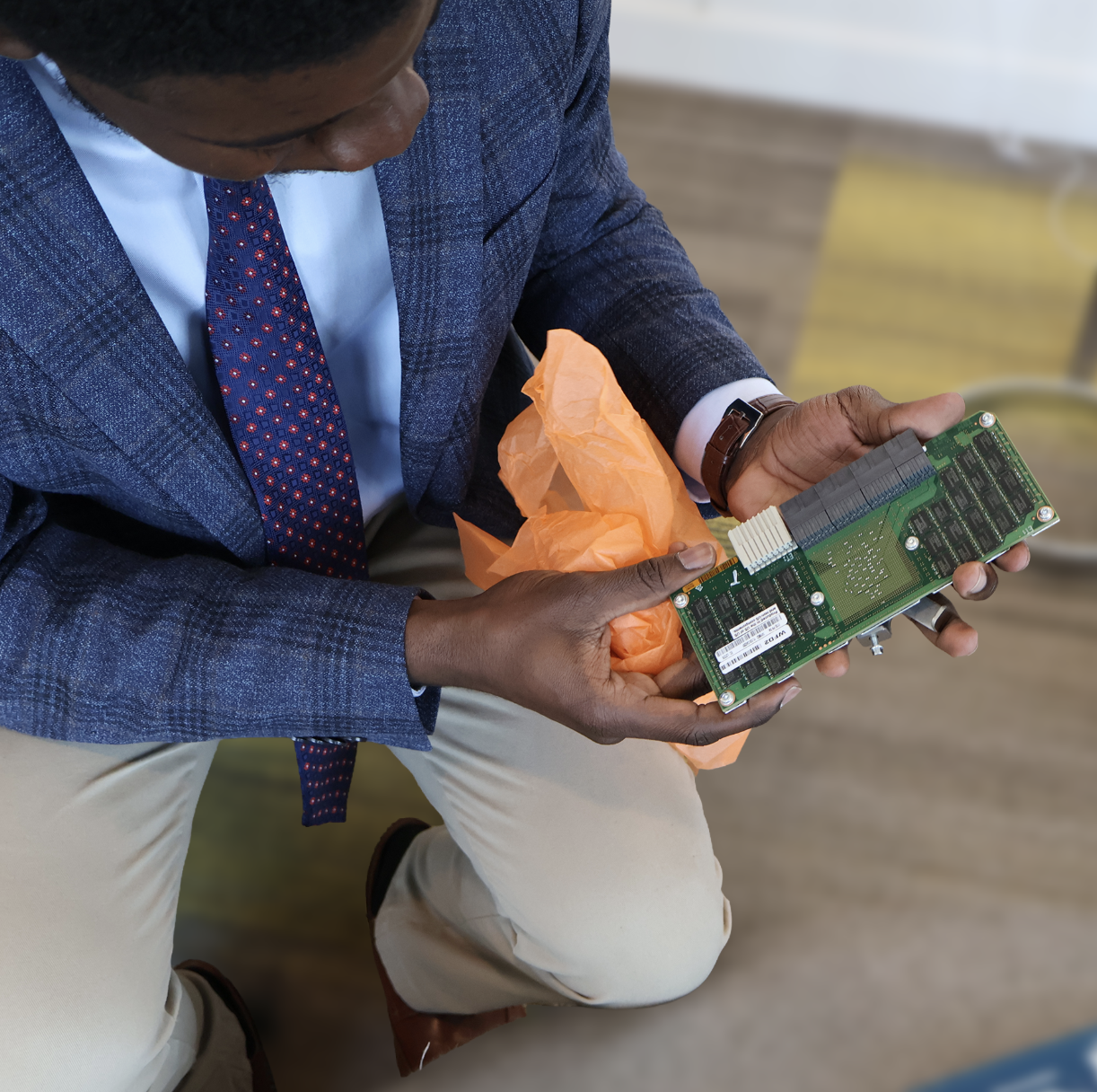
“We all came from different countries and research areas, learned together for two weeks, and then left with pieces connected to the same machine,” he said. “I like to think of it as a symbol of becoming our own kind of cluster, different people coming together to solve difficult problems.”
Making Engineering Tangible
While Boateng’s research pushed him toward increasingly complex computing systems, his teaching and outreach experiences raised a different question: Could complex engineering ideas become easier to understand if people could physically interact with them?
That question inspired MPowerBoards, an educational technology startup that transforms power grid simulations into interactive boards using LEDs, embedded electronics, displays and visualization tools. Rather than learning about a power system only through equations or simulations, students can interact with a physical representation of the system.
“I have seen how powerful hands-on learning can be,” Boateng said. “Sometimes you can explain a concept for twenty minutes, but once someone builds something or sees it working, it suddenly clicks.”
Through Georgia Tech’s CREATE-X program, Boateng received mentorship and feedback that helped move MPowerBoards from concept to prototype. He later presented the technology at CREATE-X Demo Day alongside more than 200 ventures.
MPowerBoards remains in the prototyping and validation stage as Boateng gathers feedback and refines the technology to meet educational needs.
“The research challenges me to prove that my ideas are correct. The startup challenges me to prove that my ideas are useful.”
“If we can make complex ideas easier to visualize, more people may feel confident enough to engage with engineering problems that once seemed intimidating,” Boateng said.

Boateng poses with his educational technology startup, MPowerBoards.

